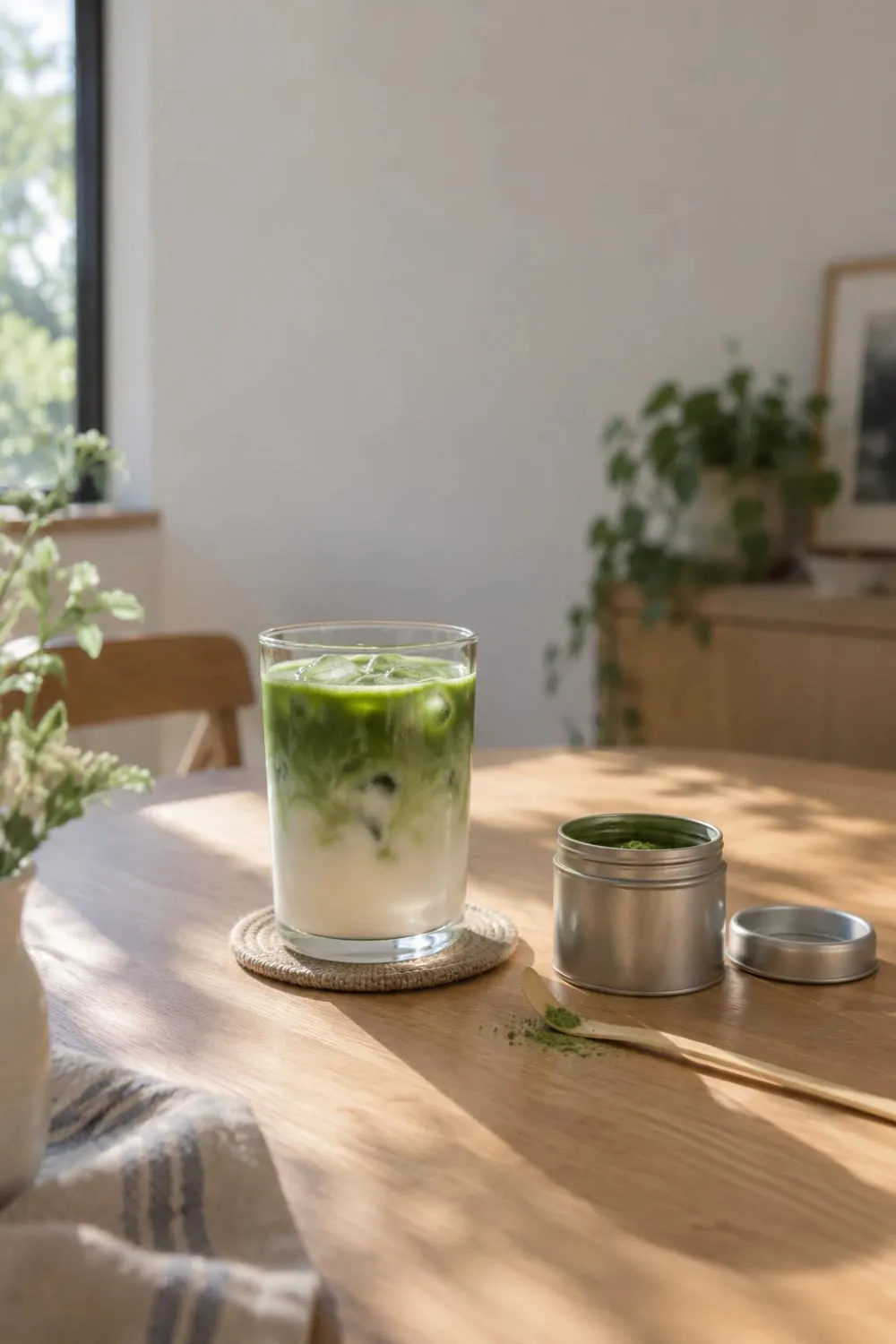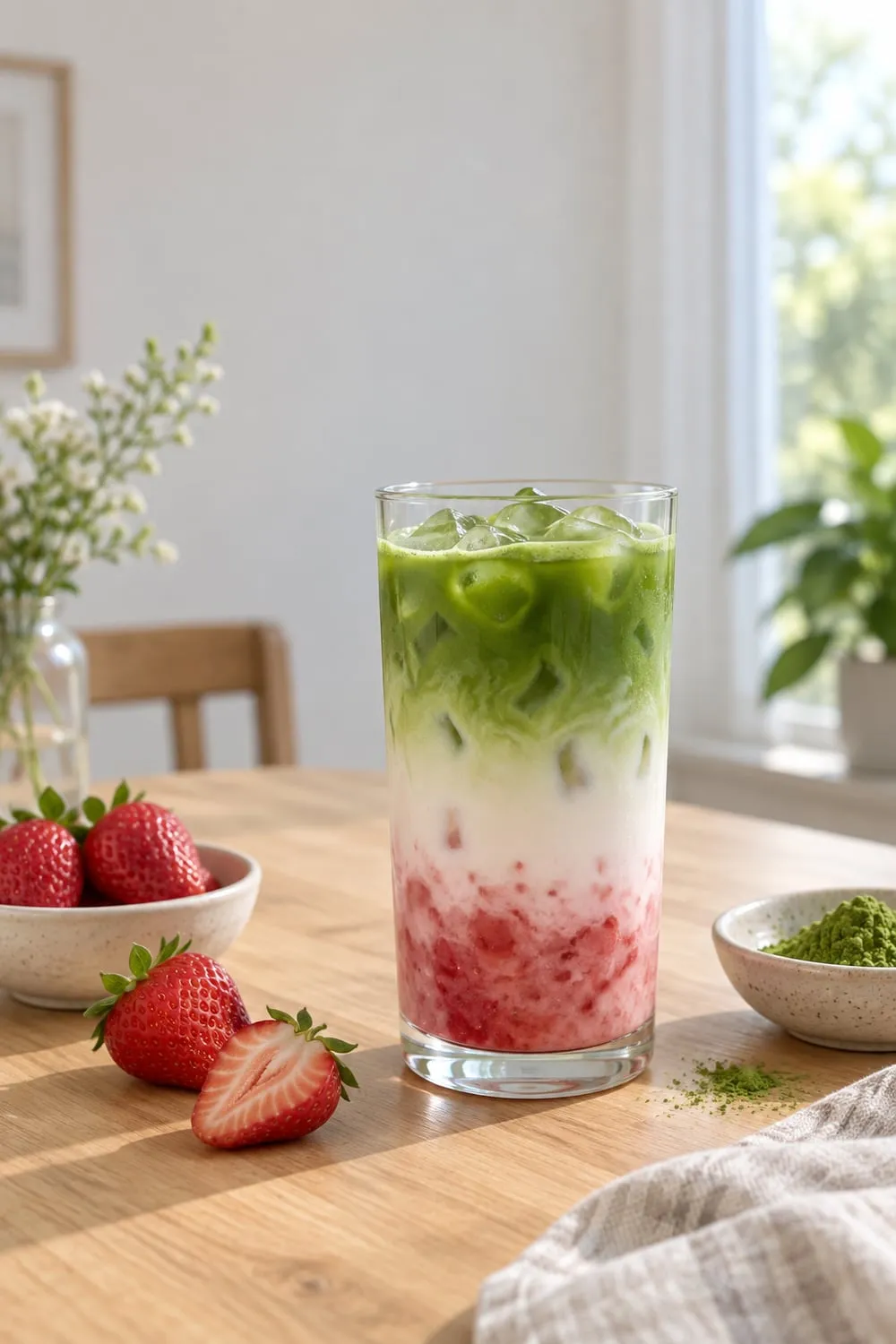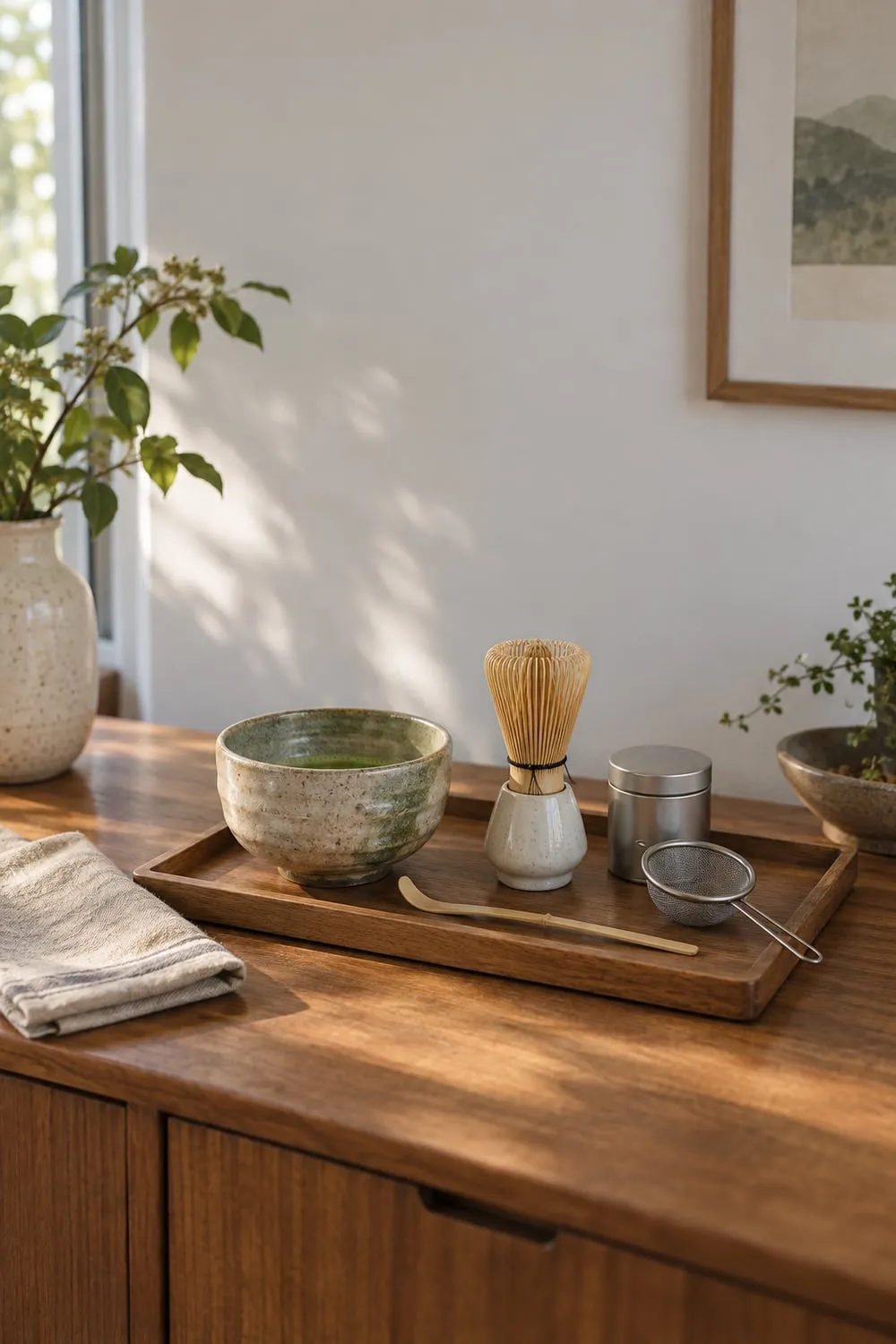
A matcha station is a small set of things kept together so that making a bowl takes thirty seconds instead of five minutes of hunting through cupboards. That’s the whole idea. Everything else about it is decoration.
I should say up front that mine isn’t on display. The bowl, the whisk and the tin live in the dish cupboard with everything else, and come out when I want them. The photographed corners with the wooden tray, the linen cloth and the row of matching jars are lovely, and they are a choice rather than a requirement. Nothing in this article depends on having one.
What does matter is that the pieces are together, that the whisk dries properly, and that the tin is somewhere sensible. Those three things are the difference between a setup you use and one you stop using.
What the setup actually needs
Four things, and you can stop there.
A bowl and a whisk. A wide, shallow bowl so the whisk has room to move, and a bamboo chasen to move through it. This is the part that decides whether the matcha comes out smooth, and there’s more on why in how to make matcha without it tasting bitter.
A whisk holder. The ceramic stand the whisk sits on. It looks like an ornament and isn’t — it helps the whisk dry while supporting the curved shape of the tines, which can extend its useful life. If you buy a set, make sure it has one.
A sifter. A small fine-mesh strainer. It’s the step everyone skips and the reason most home matcha has lumps in it.
A scoop, if you like, though a teaspoon measures the same amount.
Matcha Bowl & Whisk Set (Chawan + Chasen)
A wide, shallow bowl gives the bamboo whisk room to move, which is what produces an even foam. Look for a set that includes the whisk holder, which keeps the prongs in shape, and a sifter — the step most people skip.
View on Amazon Opens Amazon.com in a new tab. Paid link.If you’re starting from nothing, a set is usually simpler than choosing each piece separately. Look for a wide bowl, a bamboo whisk, a whisk holder and a fine sifter, and ignore the decorative extras.
That’s the equipment. The other half is the tea, and you don’t need two tins. If you mostly drink matcha with water, buy one you enjoy drinking. If you mostly make lattes or bake with it, buy one intended for that. Keeping both only makes sense if you regularly do both.
Matcha for Drinking (Japanese Grown)
If your matcha tastes harsh, the powder is usually why. Japanese origin and a clearly stated growing region are useful signs that a seller knows what it is selling — Uji, Nishio and Kagoshima are names that come up — though a famous region on the label is not by itself a guarantee of quality. A sealed tin, and a small one rather than a bargain size.
View on Amazon Opens Amazon.com in a new tab. Paid link.Matcha for Lattes and Baking
Matcha sold for culinary use is generally meant to stay noticeable alongside milk, sugar and other ingredients. The label is a useful shopping category rather than a standardized Japanese grade, so quality still varies between producers. The sensible default for baking and sweetened drinks, though using drinking matcha there is a choice some people make deliberately.
View on Amazon Opens Amazon.com in a new tab. Paid link.Where to put it
The real constraint isn’t counter space. It’s that the whisk needs air.
A bamboo whisk that goes back into a closed cupboard while still damp will not last. It wants somewhere with some air movement, out of direct sun, where it can dry completely between uses. In practice that means the whisk gets a spot of its own — on its holder, on an open shelf or a corner of the counter — even if everything else is put away.
So a reasonable arrangement is: whisk out on its holder, everything else wherever you like. Which is roughly what my cupboard-based version amounts to.
If you do want the tray on the counter, the sensible way round is to choose the tray to fit the tools rather than buying tools to fill a tray.
Looking after the whisk
This is the part that rarely gets explained, and it’s where bamboo whisks tend to get wrecked.
Never use soap, and don’t scrub it. After use, swish the whisk in a container of clean water — moving it the way you whisk, so the water runs through the tines and carries the matcha out. That’s the whole cleaning process.
Put it back on the holder while wet. The tines splay out as they’re used, and drying on the curved holder helps pull them back into shape.
Dry it in the shade, with air. Somewhere ventilated and out of direct sunlight. Not in a sealed cupboard, not on a hot windowsill, and never in a dishwasher — heat, detergent and the cycle itself can damage the fine bamboo tines.
Handled this way a whisk lasts. Handled the other way — rinsed roughly, dropped in a drawer wet — the tines eventually break and it starts shedding bamboo into your tea.
How to store matcha without ruining it
Matcha is ground to a very fine powder, so it’s far more exposed to air, light, heat and moisture than whole-leaf tea. It also picks up smells from whatever is sitting next to it.
Producers differ on the specifics, and the tin will usually say what its maker recommends — follow that first. What they agree on is the shape of the problem: keep it sealed, away from heat, light, damp and strong odors, and finish it while it’s fresh.
For what it’s worth, here’s what I do. Unopened, it goes in the refrigerator or freezer. Once it’s open, it lives in a cupboard — cool, dark and dry — rather than going back into the fridge.
That isn’t a rule so much as a way of avoiding condensation. Every time a cold tin is opened in a warm kitchen, moisture settles on the powder, and damp matcha clumps and goes stale faster than matcha kept at an even temperature.
If you’d rather refrigerate an opened tin, the way to do it is to let the container come back towards room temperature while it’s still closed, then open it. Never open it cold. And if you’ve bought a large tin, decant a small working amount rather than moving the whole thing in and out.
Beyond that, use it while the color and aroma are still there — a smaller tin you actually finish is worth more than a large one that fades in the cupboard. Fresh matcha is a vivid green. Dull, yellowish green means it’s past its best, and no technique brings that back.
What you can skip
A matcha station turns into a shopping project easily. Things you don’t need:
- A dedicated tray. Any tray, or no tray.
- Matching canisters. The tin it came in is airtight and opaque, which is exactly what you want. Decanting into a clear glass jar is actively worse.
- An electric whisk or matcha machine. A frother is genuinely useful for milk drinks, and does nothing a chasen doesn’t do better for plain matcha.
- A second bowl in another color.
- A ceremonial tea set with pieces you won’t use.
The frother is the one exception worth owning, and only if you make lattes.
Handheld Electric Milk Frother
Only needed if you are making lattes rather than straight matcha. It gives you the warm, dense foam in about twenty seconds, and breaks up any last clumps if you are in a hurry.
View on Amazon Opens Amazon.com in a new tab. Paid link.The smallest version that works
If you want the shortest possible answer: a bowl, a whisk, a holder for the whisk, a small sifter, and a tin of matcha you keep somewhere dark and dry. Keep them in the same place. Rinse the whisk in water and stand it on its holder to dry.
That’s a matcha station. It can sit on a shelf looking beautiful, or it can live in a cupboard like mine. The tea comes out the same.