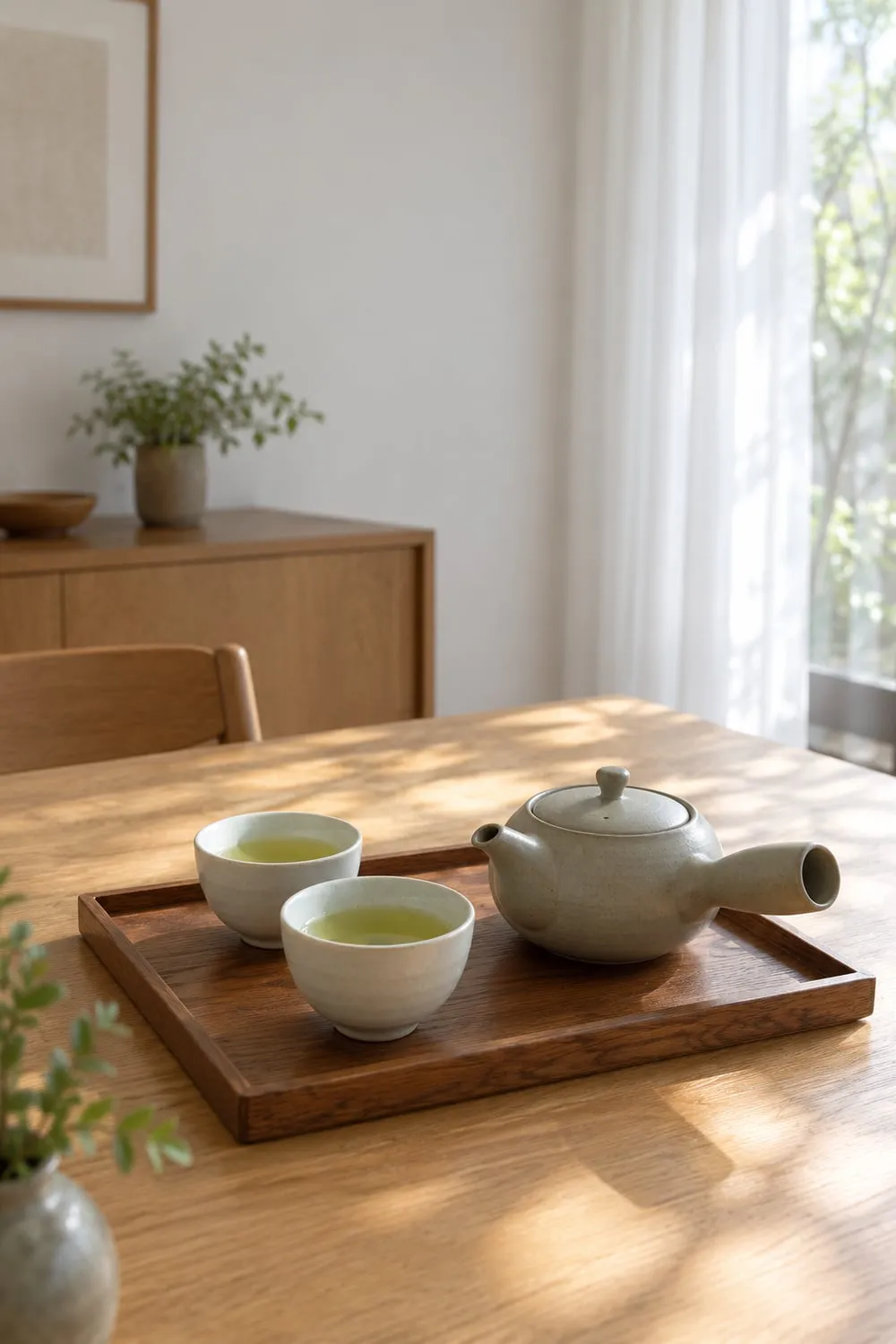
Say “Japanese tea” in English and most people picture matcha — a bowl of bright green powder, whisked to a foam. In Japan, matcha is the special one. The tea that’s actually in the pot on an ordinary afternoon is sencha, and it looks and tastes nothing like matcha: loose leaves, steeped and poured, a clear yellow-green in the cup.
I drink sencha year-round. What changes is the season, and in summer something else takes over entirely — but that’s further down.
Sencha, the everyday one
Sencha is made from whole leaves that are steamed shortly after picking, then rolled and dried. The steaming is what makes Japanese green tea taste the way it does — grassy and slightly sweet, quite different from Chinese green teas, which are usually pan-fired.
Buy it loose rather than in bags if you can. The leaves are large and need room to unfurl, and a teabag doesn’t give them any. As with matcha, a stated growing region on the packet is a reasonable sign the seller knows what it’s selling.
Loose Leaf Sencha
The everyday Japanese green tea, and the one worth buying loose rather than in bags — the leaves are large and need room to open. Look for a stated growing region on the packet, the same as with matcha.
View on Amazon Opens Amazon.com in a new tab. Paid link.In summer we drink it cold, and iced green tea here isn’t a compromise or a Western import — it’s just what you do when it’s hot.
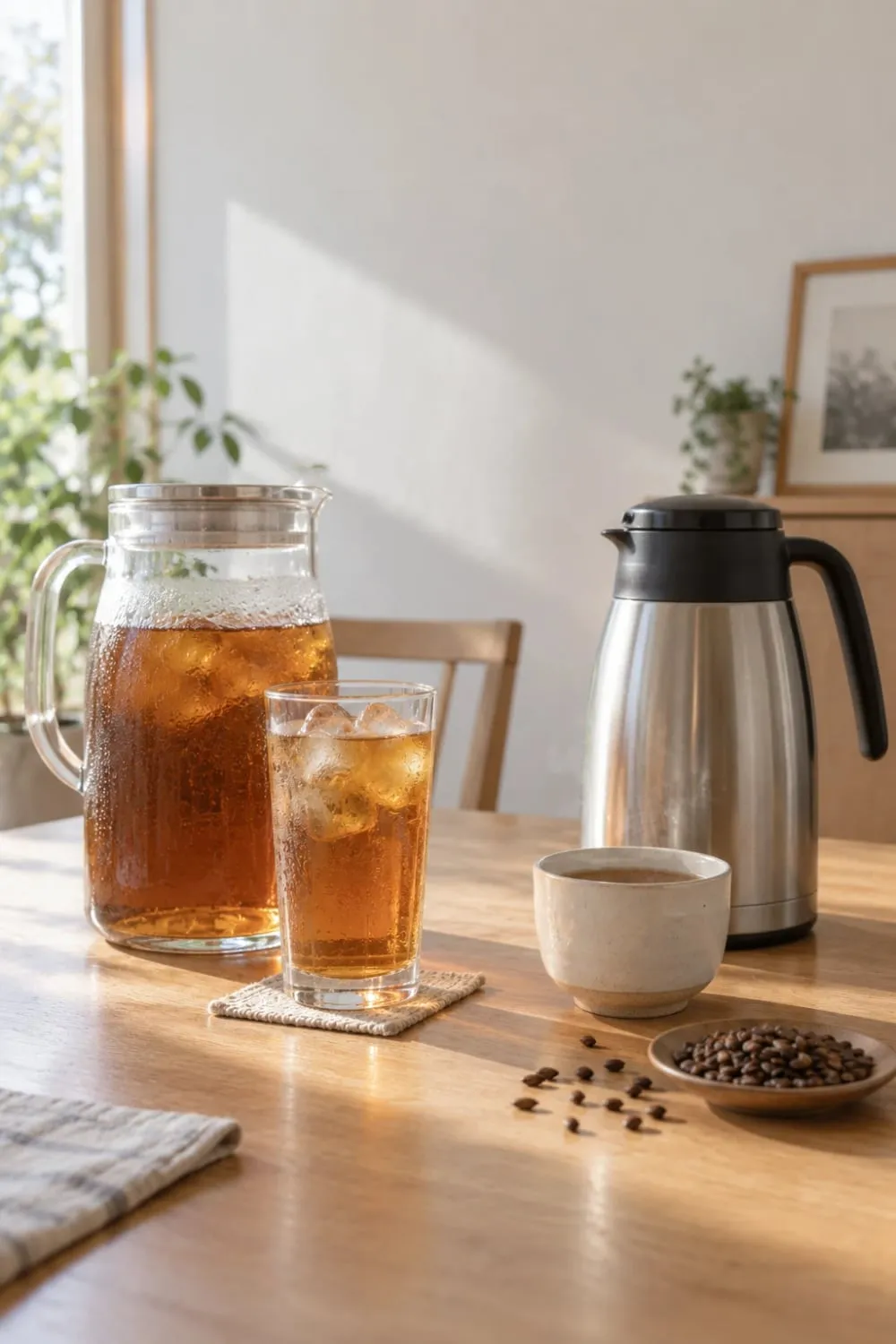
There are two ways. Cold brew: leaves and cold water in a jug, into the refrigerator for three to six hours. Slower, sweeter, almost no bitterness. Or on the rocks: brew it hot as usual and pour it straight over a glass of ice. Faster, and sharper in a way that’s good when you actually want cooling down.
One caveat with the cold-brewed version, which matters more than it sounds: tea made with unboiled water, or left steeping a long time, doesn’t keep. Drink it the same day rather than leaving the jug in the fridge for three.
Don’t use boiling water
This is the one technical thing worth knowing, and it’s the same principle as matcha: boiling water makes green tea bitter.
Sencha wants water somewhere around 160–175°F / 70–80°C. I boil it in a stovetop kettle and then let it cool — pour it into another vessel, or into the cups first, and wait a minute or two. There’s even a utensil for it, a yuzamashi, whose only job is bringing water down to temperature.
The matcha article covers the same ground in more detail, and the reasoning transfers directly.
Steep for about a minute, and pour out all of it — don’t leave liquid sitting on the leaves, or the second cup will be bitter.
The second and third cups
The same leaves are good for two or three brews, and the trick is that each one is made differently. Once the leaves are already open, they give up their flavor much faster.
- First brew: 70–80°C, about a minute.
- Second: slightly hotter, and only 10 to 30 seconds.
- Third: hotter again, and poured straight out with no steeping to speak of.
Brew the second one for a minute like the first and it will be bitter. Shorter and hotter is the whole adjustment.
The pot: a kyusu
The Japanese teapot has its handle on the side rather than the back, and a wide mesh filter built into the spout.
Both of those are doing something. The side handle lets you pour one-handed at a low angle, which is how you get the last drops out — and the last drops are the strongest, so getting them out matters. The built-in mesh means the leaves sit loose in the pot with room to open, rather than crammed into an infuser basket.
I use one every time, and I own more of them than I strictly need — they come in a great many designs and it’s difficult not to keep buying them. That isn’t collecting, exactly. It’s just what happens.
They’re small, usually 10 to 15oz, because Japanese tea is served in small cups and topped up rather than poured once into a mug.
Kyusu (Japanese Teapot)
What matters is the side handle, which lets you pour with one hand at an angle no upright pot manages, and a wide built-in mesh so the leaves have room to open. Tokoname is the clay town most associated with them, and this one is Tokoname ware.
View on Amazon Opens Amazon.com in a new tab. Paid link.If you’re new to brewing leaves, there’s an argument for a glass one instead. Being able to see the leaves open and the color come up takes the guesswork out of the timing — you stop counting seconds in your head and start judging by the tea, which is what you’d eventually learn to do anyway. It also makes the difference between the first and second brew obvious rather than theoretical.
Glass Kyusu
Heat-resistant glass, so you can watch the leaves open and the color come up instead of guessing at the timing. Hario have been making this one a long time. Larger than a typical ceramic kyusu, which is useful if you are brewing for more than one.
View on Amazon Opens Amazon.com in a new tab. Paid link.What actually carries the summer: barley tea
Here’s the thing that surprises people. Through the hot months, the drink in the fridge in my house is not green tea at all. It’s mugicha — barley tea.
It’s made from roasted barley, so it isn’t tea in any botanical sense, and it contains no caffeine whatsoever. That’s most of why it’s everywhere: children drink it, babies drink it, you can drink a liter of it at nine in the evening and it won’t keep you awake.
I make about six liters — roughly six quarts — a day in summer. That’s a lot even by local standards, and it’s mostly logistics rather than thirst: around four of those liters go into the water bottles that leave the house with lunch. Households vary. The pattern doesn’t — you make a jug, it lives in the fridge, and it empties.
The cold-brew version is what makes that practical: a bag goes into a jug of cold water, into the fridge, and a couple of hours later it’s done. No kettle, no cooling, no waiting.
Mugicha (Japanese Barley Tea)
Roasted barley, not tea leaves, so there is no caffeine in it at all. The cold brew bags are the version to get: one bag in a jug of cold water in the fridge, no kettle involved. This is what Japanese households drink through the summer.
View on Amazon Opens Amazon.com in a new tab. Paid link.It tastes roasted and faintly nutty, closer to something toasted than to a herbal tea, and it’s very slightly bitter in a way that turns out to be exactly right when you’re hot. Any jug will do — a wide-mouthed one is easier to clean.
One practical note: brewed barley tea is a fresh, unpreserved drink, so keep the jug in the fridge rather than on the counter and finish it within a couple of days. There’s more on making it, drinking it hot in winter, and what to look for when buying it in Mugicha: Japanese Barley Tea, Cold in Summer and Hot in Winter.
Hojicha and genmaicha, briefly
Hojicha is green tea that’s been roasted, which turns the leaves brown and takes most of the caffeine with it. It tastes toasty and smooth, and it’s what you might drink in the evening, or give to a child. I drink it now and then rather than daily. It’s also having a moment as a flavor — hojicha chocolate, hojicha soft serve.
Genmaicha is green tea mixed with roasted rice. The rice makes it savory and rounds off any sharpness, and it’s forgiving of water that’s a bit too hot — which makes it a good one to start with if the temperature business sounds fussy.
Neither needs different equipment. Same pot, same method, hotter water is fine for both.
Where to start
If you’re buying one thing, buy loose sencha and use whatever pot you have. If you’re buying two, add a kyusu — it changes the pouring more than you’d expect.
And if you take one idea from this rather than one purchase: the tea Japanese people actually drink isn’t the famous one. It’s sencha most of the year, and barley tea all summer.
How it gets made is another matter, and it’s changing. Brewing leaves in a kyusu is less universal than it used to be — a great deal of sencha now comes out of a bottle from a convenience store, or a teabag in a mug. I’d be describing my own kitchen rather than the country if I said everyone still brews it.
But I do, and I intend to keep doing it, because tea from a kyusu is markedly better than tea from a bottle. Not subtly better. If you’re going to drink Japanese tea at all, brew it from leaves at least once and see whether you agree.