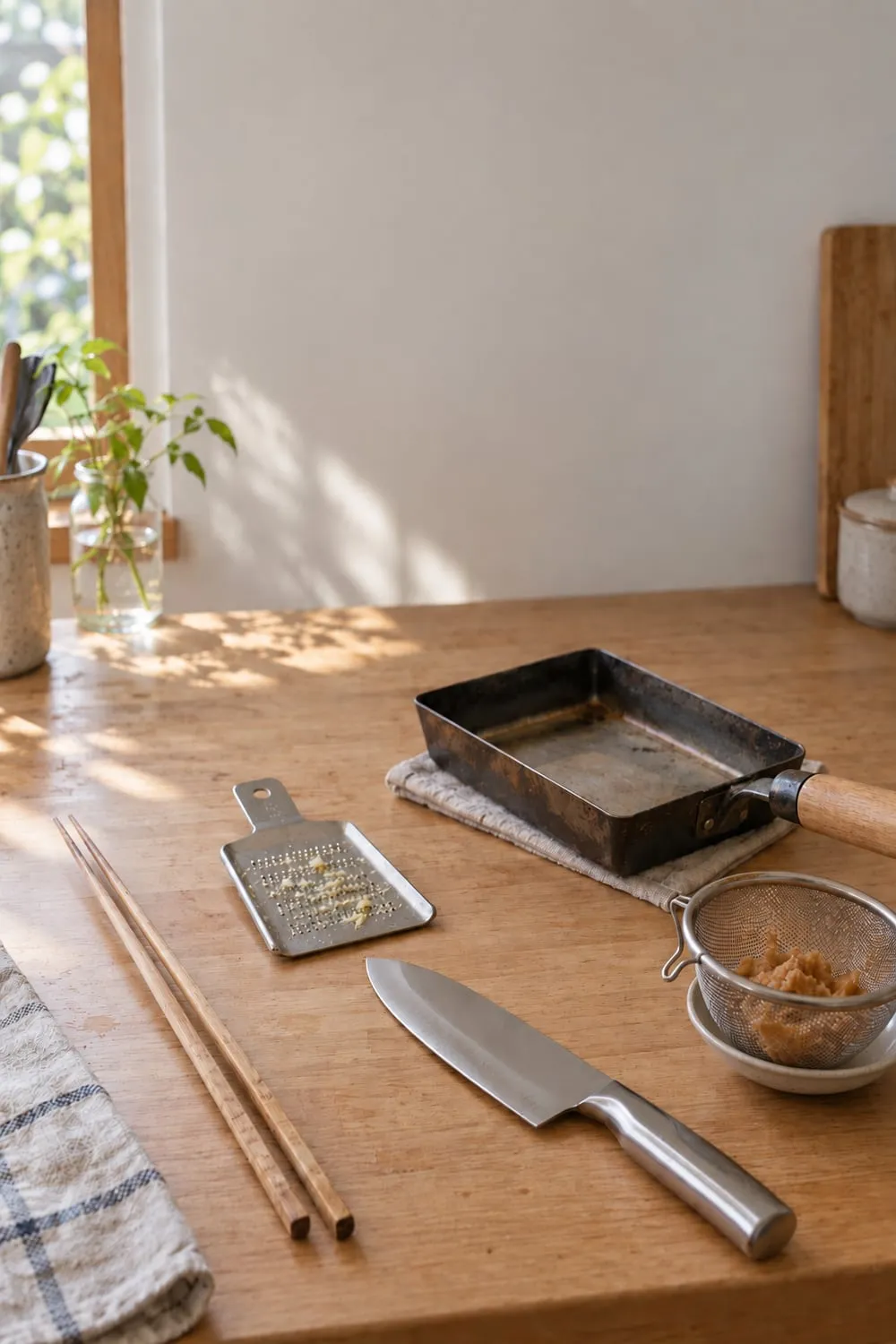
If you search for Japanese kitchen tools in English, you get a fairly consistent list: a drop lid, a sushi rolling mat, a bonito flake shaver, a mortar with a wooden pestle. Beautiful objects, photographed on wooden boards.
Here is the awkward thing. The two of those I own, I barely use — one comes out for special occasions, and the other not at all. The tools that actually come out of the drawer every single day in my kitchen are duller than that, and mostly absent from those lists.
So this is the honest version: what gets used daily, what gets used sometimes, and what I bought and left in a drawer.
The ones I use every day
Seven things, and most of them cost very little.
Long cooking chopsticks
Saibashi — chopsticks about thirteen inches long, used for cooking rather than eating.
If you take one thing from this article, take these. They turn things in a pan, lift food out of hot oil, separate noodles, beat eggs, arrange food on a plate, and pull something out of the back of the oven. Most Japanese kitchens have several pairs and no tongs at all, because tongs do one of those jobs and these do all of them.
They cost almost nothing, and they will change how you cook more than anything else here.
Saibashi (Long Cooking Chopsticks)
Thirteen inches of chopstick. They turn, lift, separate noodles, beat eggs, retrieve things from hot oil, and plate food, which is why most Japanese kitchens have several pairs and no tongs. The one item here that will change how you cook for the price of a coffee.
View on Amazon Opens Amazon.com in a new tab. Paid link.A Japanese grater
The oroshigane is not a box grater with a different shape. The teeth are much finer and set differently, and they reduce ginger, daikon or garlic to a wet pulp rather than shreds.
That difference matters because a lot of Japanese cooking asks for grated daikon or ginger and means that texture — soft, juicy, almost a purée. A Western grater gives you threads, which behave differently in a sauce.
Get one with a well underneath to catch the liquid. You usually want the juice.
Japanese Grater (Oroshigane)
Not a box grater. The fine teeth reduce ginger and daikon to a wet pulp rather than shreds, which is what Japanese recipes mean when they say grated. Get one with a well underneath — the juice matters as much as the solids.
View on Amazon Opens Amazon.com in a new tab. Paid link.A knife
I have five: two santoku in different sizes, a petty knife, a bread knife, and one for tomatoes. You need one, and it’s the santoku — the others are specialists, and the santoku is what my hand goes to without thinking.
It’s the Japanese all-purpose knife: shorter than a Western chef’s knife, flatter along the edge, made for pushing or drawing the blade through rather than rocking it. Both of those cuts come easily once the edge is flat. If you’ve only ever used a curved chef’s knife it takes a day to adjust, and then it feels obvious.
Stainless steel is the sensible choice for a first one. Carbon steel can take an excellent edge, but it needs more care to keep it from rusting.
Santoku Knife
The all-purpose Japanese kitchen knife: shorter and flatter than a Western chef knife, so it pushes and draws through food rather than rocking over it. Stainless is the sensible choice for a first one — it takes a keen edge and, unlike carbon steel, it will not rust if you leave it wet for a minute.
View on Amazon Opens Amazon.com in a new tab. Paid link.About sharpening, and who actually does it
English articles about Japanese knives tend to arrive with a whole discipline attached: a whetstone, a routine, a fear of rust. That is real for carbon steel. It is not what most Japanese kitchens look like now.
My parents’ knives were carbon steel, and they sharpened them — or rather, they had them sharpened. Knife shops do it, and every so often a sharpener sets up for a single day outside a supermarket. My mother used to take knives there; she paid about ¥500 a knife, which is a few dollars. I have never used one myself.
Mine are stainless, and I have used the same santoku for about fifteen years without sharpening it and without replacing it. Plenty of younger households own one of those small pull-through sharpeners; ours is in a drawer, unused.
I am describing my own kitchen rather than issuing advice — how often a knife needs sharpening depends on the steel, the board and how much you cook, and the maker of yours will tell you what they recommend. But if the maintenance is the part putting you off, it is worth knowing that an ordinary Japanese household is not doing very much of it.
A tamagoyaki pan
Rectangular, for the rolled omelette that goes in every bento box I make. You can make one in a round frying pan, but the square shape is what lets you roll it neatly out to the edges — which is most of why it looks the way it does.
It’s in my hands every morning, which is the only reason it’s on a list of essentials rather than a list of specialist equipment. If you don’t make bento, it’s neither.
Tamagoyaki Pan
You can make a rolled omelette in a round frying pan, but the square shape is what lets you roll it neatly out to the edges. This one is iron and made in Japan, which means seasoning it and keeping it dry; non-stick versions are more forgiving if that sounds like work.
View on Amazon Opens Amazon.com in a new tab. Paid link.A rice paddle
The flat one for turning cooked rice over so the steam escapes. A spoon compresses the grains instead of separating them.
Almost every rice cooker comes with one in the box, so you probably don’t need to buy it. It’s here because I use it daily, not because it’s a purchase.
Shamoji (Rice Paddle)
The flat paddle used to cut and fold cooked rice so the steam escapes. A spoon compresses the grains instead of separating them. Non-stick versions are worth it — plain wood needs wetting first or the rice welds to it.
View on Amazon Opens Amazon.com in a new tab. Paid link.A bowl for washing rice, and a colander for draining
Washing rice and draining it are two jobs, and they want two different things.
Wash it in a bowl, not in a colander. It’s tempting to rinse rice in a strainer under the tap, but rubbing the grains against metal mesh cracks them. Wash in a bowl, pour the water off, repeat.
I use a bowl made for exactly this: it has drain holes down one side, so you tip it and the water goes while the rice stays. It’s one of those objects that exists here and barely anywhere else, and I use it every day. It isn’t essential — any bowl works if you pour carefully — but it turns a slightly fiddly job into a one-handed one.
Rice Washing Bowl
A bowl with drain holes down one side, so you tip it and the water goes while the rice stays. Washing rice in a bowl rather than a metal strainer keeps the grains from cracking. Any bowl works if you pour carefully — this just makes it a one-handed job.
View on Amazon Opens Amazon.com in a new tab. Paid link.Then a colander, for draining. Rice once it’s washed, noodles, vegetables. Nothing Japanese is required here, and you almost certainly already own one. The one thing worth checking is the mesh: a pasta colander with large holes will lose short-grain rice through it, so the fine-mesh kind is the useful one.
I mention the colander at all only because an honest list of what I touch every day has to include it, and lists like this one usually pretend otherwise.
A miso strainer — daily for me, optional for you
I make miso soup every day, so this comes out every day. It’s a small mesh basket you hold in the broth: the miso goes in, you work it through with chopsticks or a small muddler, and it dissolves evenly instead of sinking to the bottom in lumps.
Here’s the honest part: you don’t need one. Miso dissolves perfectly well in a ladle — take a ladleful of broth, work the miso into it with chopsticks, and tip it back in. Plenty of people do exactly that. I use the strainer because I’m doing this every day, and it’s quicker and tidier.
So if you make miso soup often, it earns its place. If you make it once a month, a ladle is fine. Either way, add miso at the end with the heat low or off — there’s more on that in the pantry guide.
Miso Strainer
A small mesh basket held in the broth: the miso goes in, you work it through, and it dissolves evenly instead of sinking in lumps. A ladle and a pair of chopsticks do the same job — this is for people making miso soup often enough that tidier and quicker is worth a drawer slot.
View on Amazon Opens Amazon.com in a new tab. Paid link.The ones I use sometimes
A donabe. An earthenware pot for hot pot and rice, used directly on the burner. It holds heat beautifully and it looks the way it looks.
I use mine two or three times a month, mostly in winter. That’s my kitchen, though, not a rule about the pot — there are households here that cook their rice in a donabe every single day. For me it’s an occasional pot rather than a daily one, and that’s the only reason it isn’t in the list above.
So whether it belongs among your first purchases depends on which of those kitchens yours turns out to be.
A sushi rolling mat. A makisu is the bamboo mat for rolling maki, which I make for special occasions rather than regularly. It has a second use that tends to surprise people: wrapping a freshly made tamagoyaki in it to press it into a neat shape. I don’t bother for everyday bento, but when I want it to look right, the mat comes out.
So it isn’t an everyday tool, and I wouldn’t buy one first. But it isn’t dead weight in the drawer either.
The drawer
Now the part these articles never include.
A drop lid. An otoshibuta is a wooden lid that sits directly on the surface of a simmering dish, so the liquid circulates and everything cooks evenly in a shallow amount of broth. The technique is genuinely useful. The object is optional — a circle of baking parchment or a sheet of foil pressed onto the surface does the same job, costs nothing, and takes up no space.
I bought a proper one. I use parchment or foil.
It isn’t a bad tool. It’s one that gets recommended because it’s distinctively Japanese, which is a different quality from being frequently used — and if you’re buying from a list on the internet, that distinction is worth having.
What I’d buy
For anyone:
- Long cooking chopsticks. Cheapest, most useful, least known.
- A santoku. The one item worth spending on.
- A grater with a well, if you cook Japanese food rather than just eat it.
Depending on what you cook:
- A miso strainer, if you make miso soup regularly.
- A tamagoyaki pan, if you make bento.
- A donabe, if you’d cook rice or hot pot in it.
And not the drop lid until you’ve caught yourself wishing you had one.