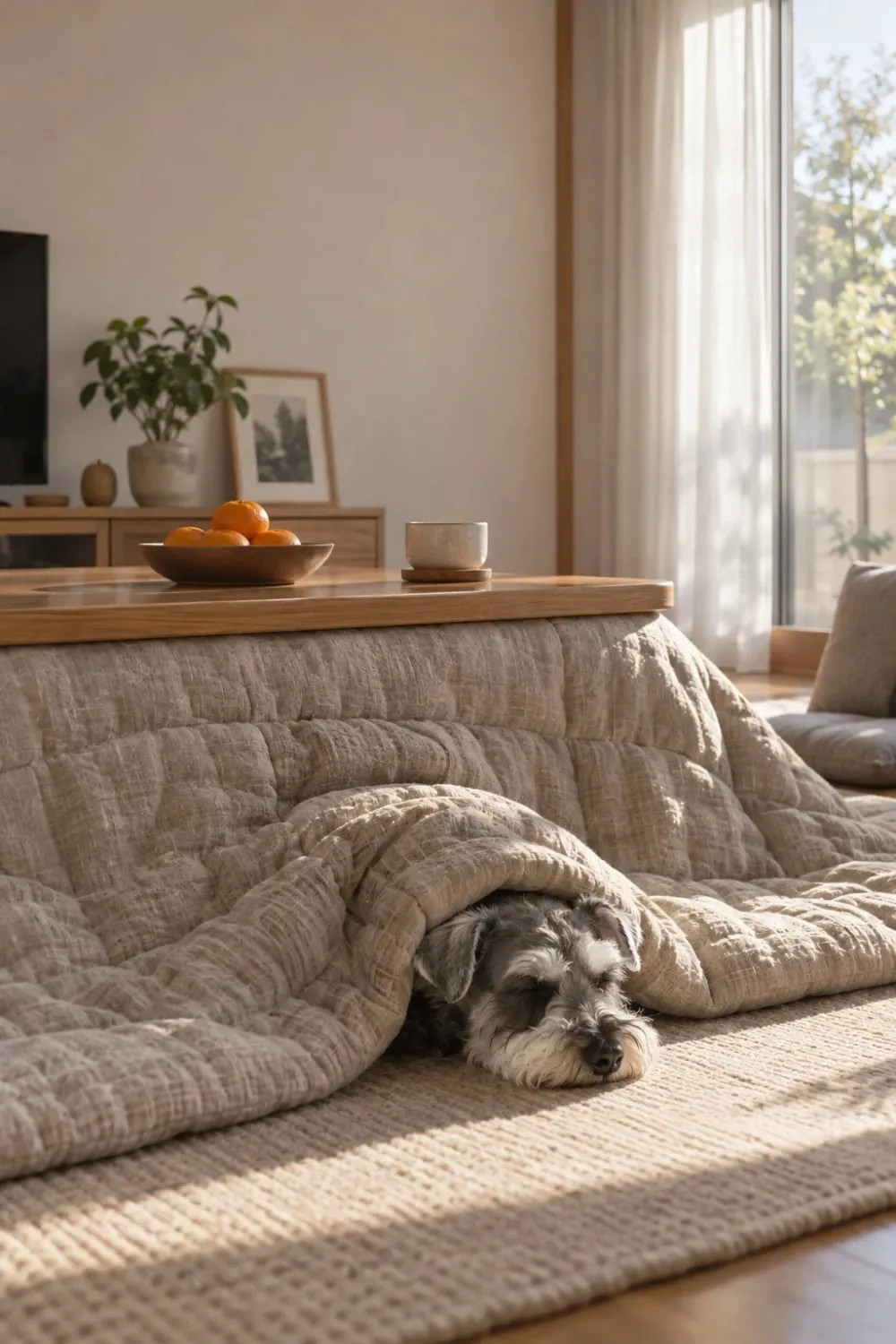
Kotatsu have been showing up more and more on Western social media, usually looking like the coziest thing in the world: a low table, a thick quilt, and someone tucked underneath it for the afternoon.
I use one every winter in Japan, from around November until April.
So before you spend money recreating one outside Japan, here is what living with a kotatsu is actually like — including the parts that are less photogenic.
What a kotatsu actually is
A standard kotatsu is a low table with an electric heater fixed to the underside of the frame.
A thick quilt, the kotatsu futon, goes over the frame, and a separate tabletop sits on top of the quilt. You sit on the floor with your legs underneath.
The futon traps the heat around your lower body instead of trying to warm the whole room.
The table, the heater and the futon work together, which is worth remembering when you’re looking at products online. A table that looks like a kotatsu isn’t necessarily a complete kotatsu.
How I use mine
Mine comes out around November and stays until about April. Once it’s there, almost everything happens around it.
We eat there. I watch TV there. I work there. Hobbies migrate there. In winter it’s simply where I end up whenever I’m home.
This is also its main disadvantage: once I sit down, I don’t want to get out.
From a sunken one to an ordinary one
When we built our house, we put a horigotatsu — a sunken kotatsu — into the tatami room.
Instead of sitting cross-legged with your legs stretched out under a low table, the floor below the table is cut away. You sit at floor level, but your legs hang down into the pit, which is much easier on the body than sitting cross-legged for hours. It had the usual heater under the tabletop, and we also kept an electric heated carpet down in the pit, so our legs were warmed from above and our feet from below.
We used it for several years. These days, though, our kotatsu is an ordinary one, set on the wooden floor of the living room. Part of the reason is that a sunken kotatsu is no good for lying down in — which, I’m aware, doesn’t sit well with what I’m about to say about sleeping in one.
That change is useful for this article, because the ordinary kind is the one you can actually buy. A horigotatsu is built into the floor of a house; it isn’t something you can order online. What I use now — a low table on the floor, where you sit beside it on a cushion or floor chair — is the same kind you’ll find listed for sale. There are also higher, dining-height kotatsu, though I haven’t used one.
It isn’t my only heat
I use the kotatsu together with other heating. When it isn’t very cold, the kotatsu alone is enough for me; when winter really arrives, the rest of the heating goes on too.
That matters if you’re picturing one in an American home. A kotatsu warms the people sitting under it. It isn’t designed to heat a house.
What a kotatsu is good at
It puts the warmth exactly where the people are.
You don’t wait for the room to heat up before you’re comfortable. You sit down, put your legs under the futon, and the warm space is right there.
I won’t make claims about whether that makes it cheaper to run than another heater — electricity prices, homes, insulation and climates vary too much for a simple comparison. What I can say from living with one is that it changes where you spend your time. In winter, mine becomes the center of daily life.
That’s very pleasant. It also makes getting up to do anything surprisingly difficult.
What nobody mentions
The photos show the good part. There are a few less attractive details.
You will not want to get up
This sounds like a joke until you’ve sat under one for a while. Once I’m comfortable, anything on the other side of the room can suddenly wait.
Whether that sounds like a benefit or a problem probably tells you a lot about whether you’ll enjoy owning one.
The futon is bulky
A kotatsu futon is not a small blanket. It spreads well past the edges of the table, because it needs enough fabric to cover your legs and keep the warm air in.
So the real footprint of a kotatsu is much larger than the table, and eventually you have to wash the thing. Washing mine is a bit of a chore — it’s big, heavy and simply more trouble than an ordinary blanket.
You sit on the floor
With the ordinary low kind, you’re at floor level for long stretches. If you already like sitting on the floor, that may not bother you at all. If your knees, hips or back make it uncomfortable, think about that before buying.
Floor chairs and cushions help, but they don’t change the height. Dining-height kotatsu exist if floor sitting is the part that gives you pause — I can’t tell you what living with one is like, but they’re worth knowing about.
About falling asleep in it
Here I have to admit something slightly contradictory.
I’ve always been told not to fall asleep in the kotatsu, and I tell my own family the same thing. Sleeping in it also feels wonderful — enough that being able to lie down in it was one of the reasons we moved away from the sunken kind. Both are true.
The warnings you’ll see in Japan from manufacturers and consumer-safety groups are about low-temperature burns from long contact with the heat, and getting dehydrated while you sleep under it. The idea that you’ll catch a chill when you finally crawl out into a cold room is more of a household saying.
I wouldn’t turn any of that into medical advice. The practical point is simpler: a kotatsu is a heater, not a bed. Follow the manufacturer’s instructions for yours.
The dog has a different opinion
Children here learn a winter song that has a line about exactly this: in the snow, the dog runs around the garden happily, and the cat curls up under the kotatsu. Cats and kotatsu are so firmly linked in Japan that the pairing turns up constantly in illustrations.
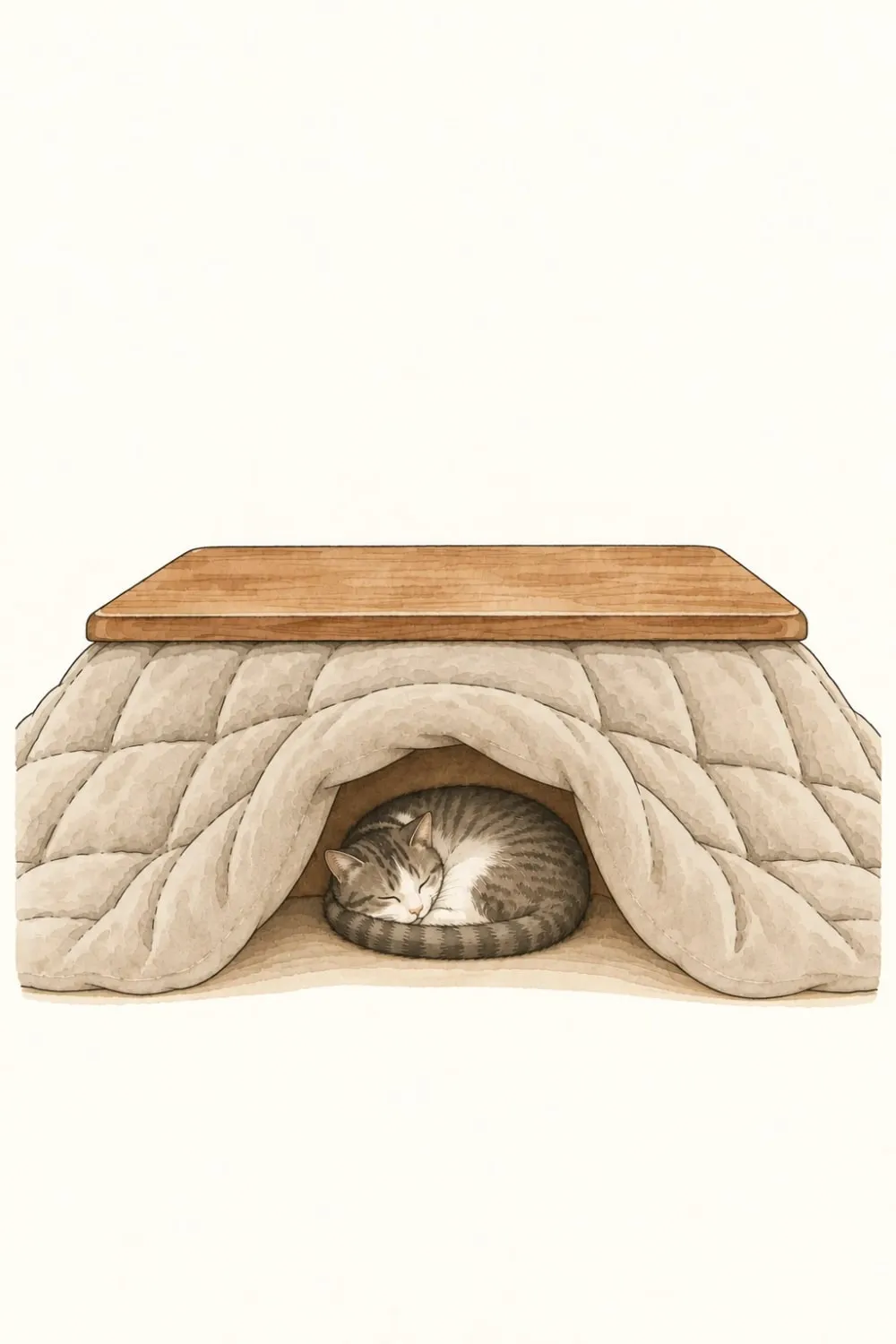
In my house the roles are reversed. My dog loves the kotatsu, and goes straight underneath the futon. When it gets too warm, just the head comes out — and then the dog falls asleep like a person tucked into bed.
I let the dog come and go as it likes. It’s one of the more entertaining parts of having a kotatsu in the house, although I suspect the dog considers it the dog’s kotatsu, which the rest of us are allowed to use.
Before you buy one outside Japan
I’ve never bought a kotatsu outside Japan, and I haven’t tested any of the ones sold on Amazon.com. So these are things to check on a product page, not recommendations from my own use.
Check the voltage
Japanese household power is 100 V; standard US outlets supply 120 V. I wouldn’t buy a heater made for the Japanese market and assume it’s fine in a US outlet just because the plug fits.
Look for a kotatsu heater or set that is specifically made and labeled for US household power, and check the electrical specifications in the listing.
Look for a safety listing
For an electric heater sold for use in the US, look for a UL Listed or ETL Listed mark in the product details. Don’t assume that every imported kotatsu sold online has been made or tested for the US market.
I should be honest about what I found when I looked: at the time of writing, I couldn’t find a kotatsu on Amazon.com whose listing clearly stated either one. That may well change, so it’s worth checking again when you shop — and note that searching for “kotatsu ETL” or “kotatsu UL” brings up plenty of results that don’t actually have either, so read each listing rather than trusting the search. The one below is made for 120 V US outlets, but its listing doesn’t mention a UL or ETL listing. If that matters to you — and for a heater you’ll sit under for hours, it would to me — ask the seller before you order.
Kotatsu Table with Heater (120 V)
Made for 120 V US outlets, with a temperature knob and an on/off switch. The listing does not state a UL or ETL listing, so ask the seller if that matters to you. Check whether a futon is included — without one, the heater warms very little.
View on Amazon Opens Amazon.com in a new tab. Paid link.Measure for the futon, not the table
A listing gives you a neat rectangle for the table. Your room will experience something much bigger. The futon extends past all four sides, and you need room to sit around it and to get in and out.
Before ordering, find the dimensions of the futon and mark out that footprint on the floor.
Check whether the futon is included
The futon isn’t decoration; it’s what makes the heater work. Without it, the heat under the table simply drifts away.
Tables and futons are often sold separately, and a photo of a table covered in a quilt doesn’t mean the quilt comes with it. Read the listing.
Kotatsu Futon
Match it to the size of the table — it should reach the floor on every side, or the heat escapes. It is also the bulkiest thing you will own that needs washing, so check the care label before you buy.
View on Amazon Opens Amazon.com in a new tab. Paid link.Think about where you’ll sit
With the ordinary low kind, you also need something to sit on: a floor cushion, or a floor chair with a backrest. You don’t need to turn your living room into a Japanese room. You do need to be comfortable at floor level for as long as you plan to stay there — which, if it works, will be longer than you expect.
So, is it worth it?
It makes the most sense if you genuinely like sitting close to the floor, want one warm place the household gathers around, and have winters cold enough that you’ll actually use it.
It won’t heat a house. But as the place where winter happens, I would miss mine very quickly.